Stop Stripping Crank Arm Threads! This $5 Tool Works Better
TL;DR: Is a Cheap Crank Arm Puller Worth Buying?
Is a cheap crank arm puller worth buying?
Absolutely. While premium tools are durable, a generic $5 crank arm removal tool is often better for stubborn cranks because it lacks a fixed handle. This allows you to use an impact driver, which utilizes rapid vibrations and “shock” torque to break seized bonds without the high static pressure that typically strips aluminum threads.
Key Takeaways
- Thread Prep is Non-Negotiable: Always clean and fully grease your crank arm internal threads before threading the tool in.
- The Real Enemy is Static Friction: Long breaker bars apply immense continuous force that often strips soft aluminum threads before breaking the taper fit.
- Impact Drivers Work Wonders: The concussive vibrations of an impact driver break the press-fit bond cleanly without tearing out the threads.
- Know Your Interface: This approach is strictly for traditional square taper spindles, not modern Shimano Hollowtech II or SRAM DUB setups.
If you’ve spent any time working on bikes-whether you’re a seasoned shop vet or a weekend grease monkey-you know the specific dread that comes with a seized square taper crank. You’ve got your crank puller tool threaded in, you’re leaning on a long-handled wrench with all your body weight, and then you hear it.
Pop.
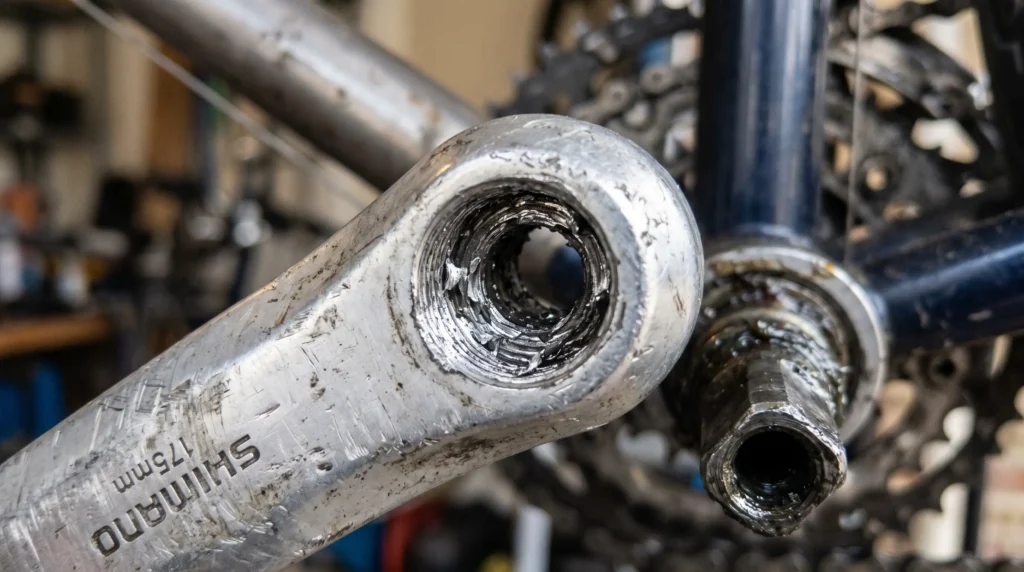
For a split second, you’re relieved. You think the crank arm finally broke free from the spindle. But then the wrench goes limp. You unscrew the tool only to find a silver coil of aluminum threads wrapped around the steel bolt. The crank is still stuck, but now the internal threads are gone. The crank arm is officially “trash.”
I’ve been a professional bicycle mechanic for over 15 years. I’ve worked on everything from $15,000 Italian racing machines to rusty 1994 mountain bikes pulled from the bottom of a lake. In that time, I’ve realized that the “gold standard” tools we’re told to buy aren’t always the best for the worst-case scenarios.
In this guide, I’m going to show you why your expensive bike crank arm remover might actually be the reason you’re stripping threads, and why a generic, $5 piece of hardened steel from the bargain bin—paired with the right technique-is the ultimate “get out of jail free” card for DIY bike repair.
Why Square Taper Cranks Get Stuck (The Physics of Frustration)
Before we talk about the tools, we have to talk about why these components hate being separated. Square taper bottom brackets (the JIS or ISO standard) have been the backbone of the industry for decades. They are reliable, but they are also a recipe for a “cold weld.”
1. The Interference Fit
Square taper systems work on an interference fit. The spindle is a slightly tapered wedge of hardened steel. The crank arm is a matching tapered hole made of much softer aluminum. When you tighten that 14mm bolt or 8mm Allen head, you are literally wedging the aluminum onto the steel.
2. Dissimilar Metals and Galvanic Corrosion
When you put aluminum in direct contact with steel, a chemical process called galvanic corrosion occurs, especially if moisture is present. Over years of bike maintenance neglect, these two metals can effectively fuse at a molecular level.
3. Factory-Installed Over-Torquing
Many entry-level bikes (looking at you, Suntour and SR) are assembled in factories using high-torque pneumatic tools. These “factory-tight” cranks are often pressed on way beyond the recommended torque specs, making them a nightmare to remove three years later.
4. Years of Riding Pressure
Every time you pedal, you are essentially “mashing” that aluminum arm further onto the steel wedge. If the crank wasn’t properly greased during assembly, time and torque turn a simple mechanical fit into a permanent bond.
The Biggest Problem with Traditional Crank Pullers
Walk into any bike shop, and you’ll see a tool with a big blue handle: the Park Tool CCP-22. It is the “official” square taper crank puller of the industry. But traditional pullers with fixed handles have an inherent flaw when dealing with remove stuck crank arm situations.
The Leverage Trap
Traditional tools rely on “static torque.” To remove a crank, you apply a slow, steady, massive amount of force. The problem? That force is being held entirely by about 10 millimeters of fine aluminum threads inside the crank arm.
When you use a long-handled tool or a cheater bar to get more leverage, you are putting immense shear stress on those threads. If the friction of the “cold weld” is stronger than the aluminum threads, the threads will simply shear off before the crank moves.
Examples from the Shop Floor:
I’ve seen home mechanics use a hammer to beat on the handle of their Park Tool CCP-22. Not only does this ruin the internal bearings of the tool, but the sudden “jerk” of a hammer blow on a fixed-handle tool often causes the tool to “jump” and strip the first few threads, leading to a catastrophic failure.
Reviewing the Park Tool CCP-22: The Professional Standard
Let’s be fair—Park Tool makes incredible equipment. The CCP-22 is a staple for a reason.
Pros
- Durability: Made of high-grade tool steel that lasts a lifetime.
- Trusted Brand: If it breaks, Park Tool usually has your back.
- Simple Design: No need for a separate wrench; the handle is built-in.
- Precision: The threading is always perfect, ensuring a snug fit.
Cons
- Expensive: Usually retails for $20–$30.
- Static Force Only: Because the handle is permanently attached, you are limited to the force of your own arms.
- Difficulty on Seized Cranks: It doesn’t allow for the use of power tools or “shock” torque.
- Weak Thread Protection: It can easily overpower the threads on cheap, soft aluminum cranks.
The CCP-22 is a great bicycle repair tool for 90% of jobs. But for that 10% that are truly stuck? It’s often the wrong tool for the job.
The $5 Generic Crank Puller: The Unlikely Hero
Now, let’s look at the “cheap” alternative. You’ve seen these on Amazon or eBay—unbranded, silver-colored, and costing less than a latte.
Construction
The $5 crank puller tool is a simple two-piece design:
- The Outer Cup: A 22mm threaded sleeve that screws into your crank.
- The Forcing Bolt: A heavy-duty bolt that threads through the cup to push against the axle.
Most of these come with a removable “hat” or axle protector that allows it to work with both standard square taper and larger Octalink/ISIS spindles.
Why It Works
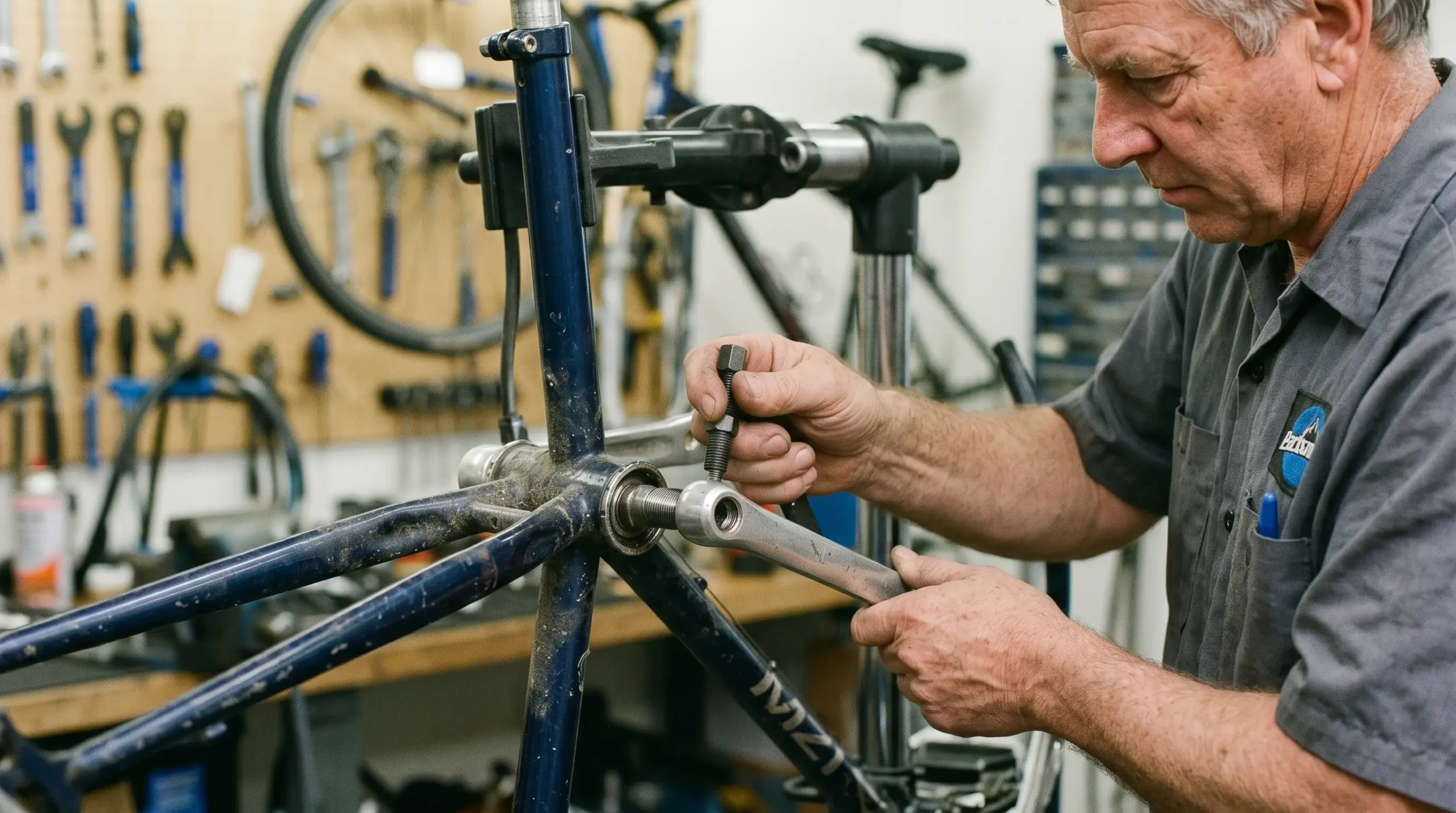
The secret isn’t in the quality of the steel (though it’s surprisingly decent); it’s the lack of a handle. The back end of the forcing bolt is usually a 15mm or 16mm hex head. This design allows you to use a socket wrench, a long breaker bar, or—most importantly—an impact driver.
Why an Impact Driver Changes Everything
This is the “pro tip” that separates the frustrated DIYer from the expert mechanic. In my shop, I rarely use a manual wrench for square taper crank removal anymore. I reach for my 1/4″ hex impact driver.
The Mechanical Advantage of Vibration
An impact driver doesn’t just turn; it hammers. It applies rotational force in thousands of tiny “pulses” per minute.
When you use an impact driver on a crank arm removal tool:
- The vibration helps break the “stiction” and corrosion between the aluminum and steel.
- The “shock” of the impact pops the crank loose before the aluminum threads have time to yield or strip.
- There is zero side-loading. When you pull on a long wrench handle, you are naturally pulling the tool slightly to one side, which puts uneven pressure on the threads. An impact driver applies pure, centered rotational torque.
It is significantly safer for the bike to use “low-torque, high-vibration” than “high-torque, zero-vibration.”
Real-World Test Results: The $5 Tool in Action
I recently had a 1998 Trek 820 come into the shop. It had been sitting in a damp shed for a decade. The Suntour crank arms were essentially part of the bottom bracket at this point.
The Traditional Attempt:
I tried my Park Tool CCP-22 first. I leaned into it until I could feel the handle flexing. The crank didn’t budge. If I had pushed any harder, the threads would have turned into silver glitter.
The $5 Tool + Impact Driver:
I swapped to the generic “no-name” puller. I made sure to thread the outer cup all the way in (critical step!). I put a 16mm socket on my Milwaukee impact driver and gave it a few short bursts.
- Rat-tat-tat-tat—
- Pop.
The crank arm slid off like it had been held on by magnets. No heat required, no hammers, and—most importantly-the threads on the crank arm were perfectly intact. This is why I tell people that DIY bike repair doesn’t always require the most expensive kit.
Compatibility: Will This Tool Work for Your Bike?
Before you buy, you need to make sure you’re looking at a square taper crank.
Use this tool for:
- Standard Square Taper: Common on vintage bikes, budget MTBs, and road hybrids.
- Shimano/Suntour/SR: Most older groupsets from these brands use this 22mm x 1 thread standard.
- Cotterless Cranks: If your crank is held on by a bolt or nut covered by a plastic cap, this is likely what you need.
Do NOT use this tool for:
- Hollowtech II / SRAM GXP: These have a large hollow spindle and require a completely different tool.
- SRAM DUB / BB30: These are usually “self-extracting” and don’t require an external puller.
- Press-Fit: Carbon cranks often require specialized bearing pullers that don’t use threads at all.
Pros and Cons: Park Tool vs. The $5 Challenger
| Feature | Park Tool CCP-22 | Generic $5 Puller |
|---|---|---|
| Cost | $25 – $32 | $5 – $8 |
| Power Tool Compatible | No | Yes |
| Built-in Handle | Yes | No (Needs a wrench/socket) |
| Thread Precision | 10/10 | 8/10 |
| Best For | Daily shop use | Seized/Stuck cranks |
| Risk of Stripping | Moderate | Low (with impact driver) |
Who Should Buy This Tool?
The Home Mechanic
If you’re only going to do this job once or twice a year, the $5 tool is a no-brainer. It saves you $20 that you can spend on better tires or a high-quality chain.
The Mountain Biker
MTBs take a lot of abuse. Mud, water, and pressure washing lead to seized parts. Keeping a cheap crank puller tool in your toolbox is essential for mid-season bottom bracket swaps.
The Budget Cyclist
If you’re restoring a “Facebook Marketplace find,” you likely don’t want to spend more on the tools than you did on the bike.
Who Should Stick with Park Tool?
If you are a professional working on 10 bikes a day, the Park Tool CCP-22 is better for ergonomics. It’s faster to grab and use on bikes that aren’t seized. It’s also made of a higher grade of steel that won’t round off over thousands of uses. But even pro mechanics should have a “cheap” handle-less puller in their drawer for the nightmare jobs.
Safety Tips: How to Avoid a $100 Mistake
Even with the best bike crank arm remover, you can still mess it up if you’re careless. Follow these shop rules:
- Clean the Threads: Before you screw the tool in, use a pick or an old toothbrush to get the dirt out of the crank arm’s internal threads.
- Grease the Tool: Put a drop of oil or grease on the forcing bolt of the tool. This reduces friction and makes the extraction smoother.
- The “Golden Rule” of Threading: Screw the outer cup in by hand first. It should go in smoothly. If it feels tight after two turns, you’re cross-threading it.
- Bottom It Out: Use a wrench to make sure the outer cup is fully seated against the bottom of the crank hole. If it’s only halfway in, you will strip it.
- Remove the Washer: Some crank bolts have a small washer behind them. If you leave it in, your tool will push against the washer instead of the spindle, and you’ll destroy the threads.
Frequently Asked Questions
Can a cheap crank puller damage my crank?
Only if you cross-thread it or don’t screw it in all the way. The tool itself is made of steel, which is stronger than your aluminum crank. As long as the threads are fully engaged, the tool is safe.
Why do crank arm threads strip?
99% of the time, it’s because the tool wasn’t threaded in deep enough. The user only threads it in 3 or 4 turns, and when they apply force, those few threads can’t handle the load.
Is an impact driver safe?
Yes, for this specific job. Because you are using the impact driver on the tool, the vibration is helping the part release. However, don’t use a massive 1/2″ automotive impact; a small 1/4″ driver is plenty.
Can I reuse a stripped crank arm?
If you’ve already stripped the threads, the arm is usually dead. There are “re-threading” kits (like those from Unior), but they cost more than a new crank arm.
Should I grease my crank puller threads?
Yes! Greasing both the internal and external threads of the tool ensures that the force you apply is going toward removing the crank, not fighting the friction of the tool itself.
Final Verdict
You don’t always need to pay a premium for the “big blue brand” to get professional results. While Park Tool makes legendary equipment, the humble $5 generic crank puller is actually more versatile for the average DIYer because it allows for the use of an impact driver.
If you’re struggling to remove a stuck crank arm, stop pulling on that long wrench. Go buy a handle-less puller, grab your impact driver, and let physics do the hard work for you. You’ll save your back, your wallet, and-most importantly—your crank arm threads.
Recommended Crank Arm Removal Tools
1. Budget Generic Square Taper Crank Puller
- Best for: Most DIYers and seized crank removal.
- Main Features: Handle-less design, hardened steel, 16mm hex head.
- Pros: Ultra-cheap, impact driver compatible.
- Cons: Requires a separate wrench or socket.
2. Park Tool CCP-22
- Best for: Frequent use on well-maintained bikes.
- Main Features: Built-in handle, premium tool steel, 22mm x 1 thread.
- Pros: Ergonomic, very durable, industry standard.
- Cons: Expensive, no impact driver compatibility.
3. Park Tool CCP-44
- Best for: Splined systems like Shimano Octalink and ISIS.
- Main Features: Larger “pusher” tip specifically for hollow spindles.
- Pros: The best tool for splined cranks.
- Cons: Will not work on standard square taper.
4. BikeHand Crank Puller
- Best for: Those who want a handle but are on a budget.
- Main Features: Includes a long handle and an adapter for Octalink.
- Pros: Great value-to-performance ratio.
- Cons: Handle can be a bit thin for extreme seized cases.
5. Oumers Bike Crank Puller
- Best for: Complete beginners (often comes in a kit).
- Main Features: Simple two-piece design similar to the generic model.
- Pros: Usually comes with a 16mm spanner included.
- Cons: Steel quality is slightly lower than professional tools.